Research Philosophy
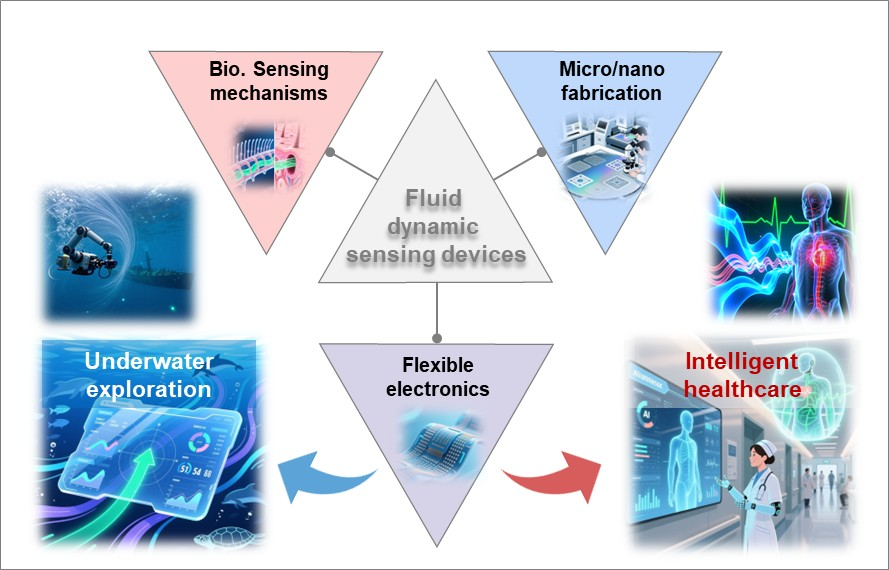
Flexible fluid dynamic sensing devices can be conformally integrated with complex curved surfaces, enabling in situ and real-time monitoring of fluid dynamics. By leveraging principles from biological sensory systems, advanced micro/nanofabrication techniques, and flexible electronics, we aim to develop high performance flexible fluid dynamic sensing devices. These devices are expected to facilitate a range of engineering applications, including underwater exploration and intelligent healthcare.
3. Bio-integrated flexible flow sensors for intelligent healthcare
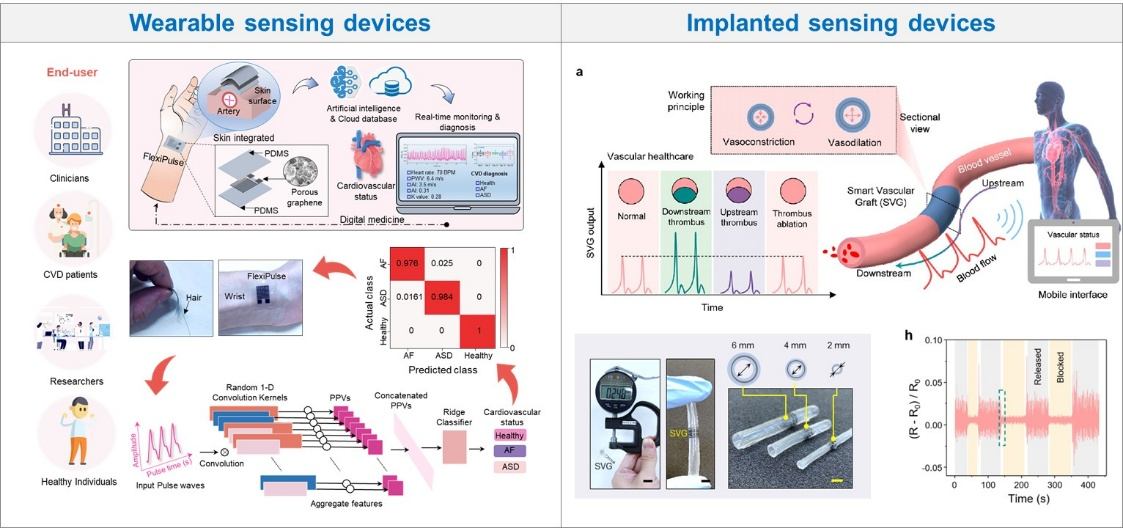
Cardiovascular disease (CVD) remains the leading cause of mortality worldwide. Hemodynamic monitoring plays a crucial role in its prevention and postoperative management. However, current clinical hemodynamic monitoring equipment is often costly, bulky, and limited to intermittent monitoring. Flexible flow sensors offer a promising solution for real-time and continuous hemodynamic monitoring. We have developed two types of flexible sensors—wearable and implantable—for hemodynamic assessment, achieving clinical-grade monitoring accuracy and enabling diagnosis of related conditions.
2. High-performance hydrodynamic pressure sensing devices
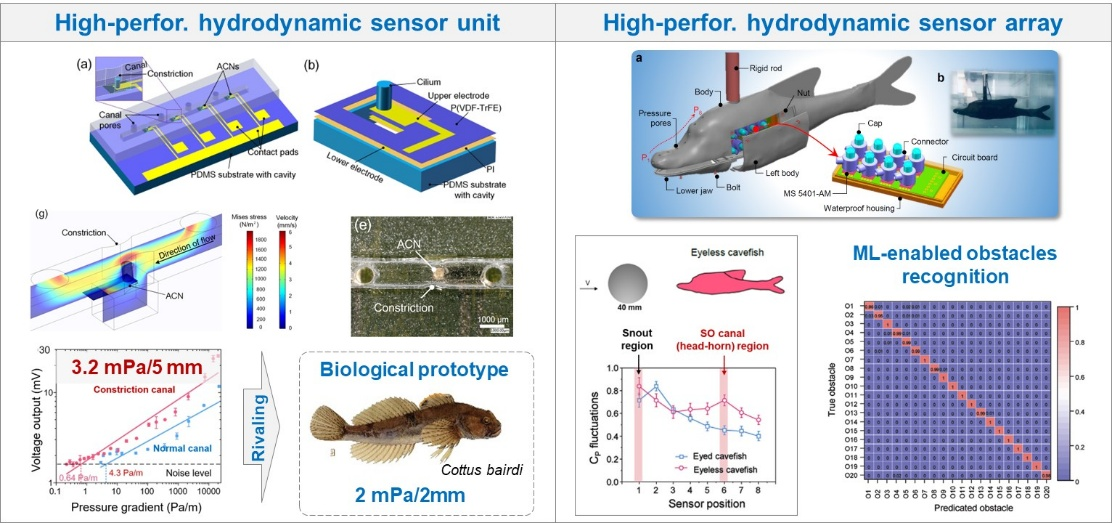
Most existing hydrodynamic pressure sensors are rigid and offer limited detection capability, hindering high precision detection of underwater flow fields. To address this limitation, we mimicked the flow sensing enhanced mechanism of the constricted canal structure in the cavefish lateral line and developed a series of highly sensitive flexible hydrodynamic pressure sensors. The detection performance improved from the commercial level of 1 Pa to 3.2 mPa, rivaling that of the biological prototype (2 mPa). Motivated by the flow-sensing enhanced mechanism enabled by the head-horn body shape in eyeless cavefish, a high performance hydrodynamic pressure sensor array was developed. By integrating the acquired hydrodynamic information with intelligent algorithms, high accuracy identification of underwater obstacles was realized. The proposed high performance hydrodynamic pressure sensors show promise for future integration onto platforms such as underwater robots for underwater exploration.
1. Enhanced flow-sensing mechanisms in eyeless cavefish
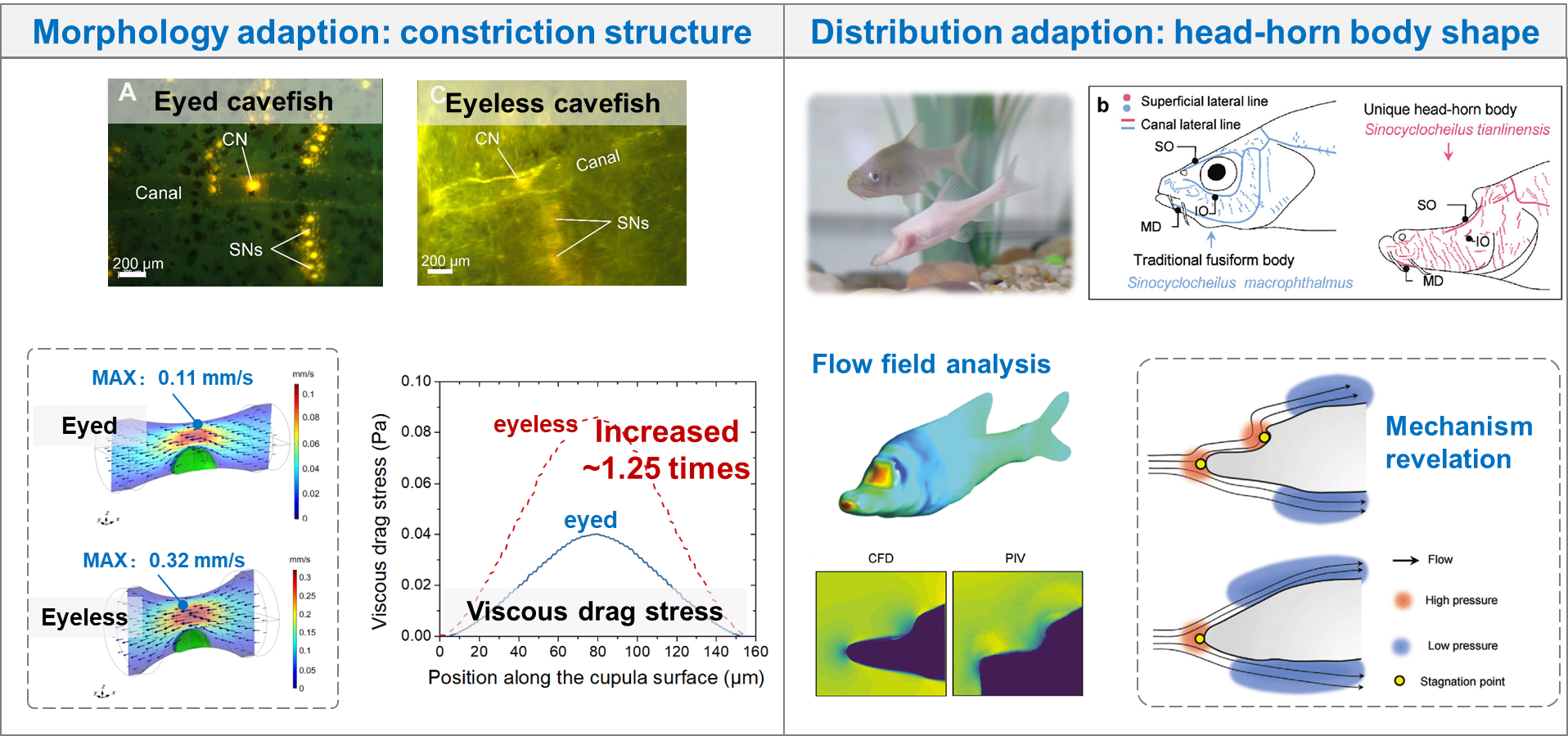
Given cavefish lateral line system as an example, we have investigated its flow-sensing enhanced mechanisms, from different levels. Cavefish lateral line system has typical adaption evolution including morphology and distribution adaptions, enabling high-precision hydrodynamic perception in complex aquatic environments. From a microscale perspective, we elucidated the role of constriction structure-induced flow enhancement, paving the way for the design of high-performance hydrodynamic pressure sensor units. Moreover, we explored the functional significance of the unique head-horn body shape in eyeless cavefish, which informed the development of an advanced hydrodynamic pressure sensor array.